UK Managers: 3 Layoff Conversation Scripts to Read Aloud

Say this: “I need to tell you that your role is being made redundant, and today, [date], is your last working day.” Then stop talking. That single sentence, delivered in the first thirty seconds, does more to protect the employee’s dignity and your organisation’s legal standing than any softening preamble ever will. Everything else in the meeting exists to support that one line.
TL;DR:
- Managers should deliver the layoff announcement immediately, focusing on ownership and clarity, without ramp-up or euphemisms, to minimize distress and maintain dignity.
- Providing specific logistical details such as severance amount, final pay date, and benefits contacts ensures the employee leaves with clear next steps and reduces confusion.
- Practicing the script through voice-based rehearsal tools helps managers handle pushback and silences effectively, especially for difficult questions like “why me?”.
- Managers must understand and record meaningful consultation processes and legal obligations before the meeting to ensure compliance and mitigate legal risks.
- Clear, concise responses to common questions like appeals and references are essential, with managers deferring complex queries to HR and avoiding promises beyond their control.
Table of Contents
- Three sample scripts for redundancy and termination conversations
- Why each part of the conversation exists
- What are your legal and consultation obligations?
- Pre-meeting checklist before you deliver the news
- How should you answer the hardest questions?
- Practising the script before the real meeting
- What managers actually regret afterwards
- Practise the conversation before you’re in the room
- Where to read the primary guidance
- Sources
- FAQ
Three sample scripts for redundancy and termination conversations
Every layoff conversation script needs to flex for the situation without losing its backbone: clear decision, brief reason, then logistics. Below are three versions you can lift directly into a briefing document for HR sign-off. Adjust names, dates and figures, but keep the structure intact.
1. Straightforward role elimination
“Thank you for making time. I have some difficult news. As part of a restructuring decision, your role of [job title] is being eliminated, and your employment will end on [date]. This isn’t about your individual performance. I know this is a shock, so take a moment if you need one.” Pause. Let silence sit. Then move to logistics: “HR will walk you through severance, your final pay date and what happens with your benefits. I want to make sure you leave here with clear next steps, not just a decision.”
2. Redundancy after a consultation process
Where employees have already been through a consultation period, acknowledge it briefly rather than re-litigating it. “As we discussed during the consultation process, the decision has been made to proceed with redundancy for your position, effective [date]. We looked at the alternatives raised, including [redeployment/reduced hours], and this was the outcome. HR has your severance details ready, and I want to answer any practical questions you have today.” This version works because it signals the process wasn’t a formality. That matters: ACAS guidance is explicit that consultation must be meaningful and documented, and employees can usually tell the difference between a genuine review and a rubber stamp.

3. Termination following a performance process
When a Performance Improvement Plan or formal warnings preceded the decision, stick to facts already on record. Avoid new criticisms invented for the meeting. “We’ve been through the performance improvement plan together over the past [timeframe], and the agreed targets weren’t met by [date]. Based on that, we’ve made the decision to end your employment, effective today. I know this is hard to hear. HR will go through your final pay and any outstanding items now.”
For every version, hand over the same short logistics block once the decision has landed:
- Final working day and last pay date, stated as calendar dates, not “soon”
- Severance calculation and when it will be paid, or when HR will confirm it
- What happens to benefits, equipment, building access and email
- A named HR contact for questions after the meeting
Keep each script under a minute of actual talking before you pause for a response. Longer preambles don’t cushion the blow. They just delay it.
Why each part of the conversation exists
A layoff conversation script isn’t one block of text. It’s five distinct segments, each with a job to do, and each with a failure mode if you skip it or over-explain it.
- Opening. State the decision in the first two sentences. Practitioner guidance on layoff communication consistently finds that burying the decision under context or small talk damages trust and increases distress, because the employee spends the preamble bracing rather than listening. Never say “we need to have a chat about your future” when you mean “your role is ending.”
- Reason and ownership. Give one or two sentences of business rationale. Own the decision with “I” or “the company decided,” never “they decided” or “it was decided.” Avoid comparing this employee to colleagues, even implicitly.
- Support and logistics. Cover severance, final pay, benefits continuation, references, and outplacement support in plain terms. This is the part employees replay afterwards, so accuracy beats warmth here.
- Closing. Don’t fill the silence. Set one follow-up point, usually HR, for anything beyond what you can answer today, and end the meeting rather than letting it drift.
Pro Tip: Write your opening line on a card and read it verbatim, even if it feels stiff. The moment you improvise the first sentence is the moment euphemisms creep back in.
Research into layoff communication backs the structure: employees report higher perceived fairness when their direct supervisor delivers the news rather than a stranger from HR, and respectful, direct interaction measurably softens negative attitudes towards the organisation afterwards. That’s the case for using a manager-led script rather than outsourcing the moment entirely.
What are your legal and consultation obligations?
A well-written script means nothing if the process behind it falls short. Before any redundancy notification meeting, managers need a working grasp of consultation law, even if HR or legal counsel handles the fine detail.
- Consultation must be meaningful. ACAS is clear that this means genuinely listening to alternatives an employee raises, such as reduced hours or redeployment, and being able to show you considered them, not just recorded that a meeting happened.
- Collective consultation thresholds apply at volume. Proposing 20 or more redundancies at one establishment within 90 days triggers formal collective consultation requirements and minimum timescales, so check headcount before assuming an individual-style script is appropriate.
- Document everything. Keep dated notes of consultation meetings, alternatives discussed and reasons for rejecting them.
- Get counsel review before the meeting, not after. A script that hasn’t been checked against your specific consultation history is a liability, not a time saver.
A large majority of HR leaders either conducted or planned layoffs recently, and 78% now consider workforce reductions a regular part of running a business. Managers who treat layoffs as a rare, one-off event tend to under-prepare precisely because they assume they won’t need the skill again.
Never promise specific outcomes on appeals, references, or rehire in the meeting itself. If an employee asks a legal question you can’t answer accurately, say so and refer it to HR: “That’s a fair question, and I want to give you the right answer rather than a guess. Let’s get HR to confirm that today.”
Pre-meeting checklist before you deliver the news
Preparation is what separates a composed five-minute conversation from a chaotic twenty-minute one. Run through this before you walk in:
- Confirm the final decision, sign-off and whether HR will be present in the room or on the call.
- Print your script and read it aloud once, in full, before the meeting. Silent reading hides awkward phrasing that only shows up when spoken.
- Note the two or three questions you’re most likely to face and decide, in advance, which ones go straight to HR.
- Prepare a one-page written summary covering severance, final pay date and benefits contacts, so the employee leaves with something in hand, not just a memory of a hard conversation.
- Decide the timing, room and how personal belongings will be handled, including whether the employee packs immediately or returns later.
- Book time with HR immediately after the meeting, and don’t schedule back-to-back calls straight afterwards. You’ll need a few minutes yourself.
How should you answer the hardest questions?
However well you script the opening, employees will push back, and a redundancy conversation script that only covers the announcement leaves you exposed the moment someone asks “why me?”
- “Why me?” Describe the selection criteria and process, not the person. “The decision was based on [role redundancy across the team / restructuring criteria], not an assessment of you individually.” Never compare the employee to a colleague, even to reassure them.
- “Can I appeal this?” State the actual appeal process if one exists, and route the question there rather than debating the decision live in the room.
- Anger or silence. Let it happen. Don’t rush to fill it with reassurance you can’t back up.
- Detailed financial questions. Defer calmly: “HR has the exact figures and will confirm those with you today.”
- References and rehire. Give only what you can honestly commit to: “I’m happy to provide a reference on your work here” is safer than promising future opportunities you don’t control.
Pro Tip: Rehearse the “why me?” question specifically. It’s the one most likely to knock a manager off script, because it invites exactly the kind of comparison you need to avoid.
Practising the script before the real meeting
Reading a script silently and saying it aloud under pressure are two different skills, and the gap between them is where most managers freeze. Three short rehearsals cover it:
- Read-through. Say the whole script aloud, alone, to catch clunky phrasing.
- Pushback simulation. Have someone play the employee and interrupt with “why me?” or go quiet on you, so you feel what silence actually costs.
- Logistics run. Practise the handover to HR details without shuffling papers or losing your thread.
Voice-based rehearsal tools built for this kind of practice, rather than a colleague reading from a script, help with two things scripts alone can’t teach: tolerance for silence, and staying on message when someone pushes back unpredictably. A 7-step rehearsal method built around exactly this problem is worth working through before a high-stakes meeting. Record one run and listen back. Rushed pacing and nervous filler words are far easier to hear than to feel in the moment.
What managers actually regret afterwards
The regret I hear about most often isn’t the words chosen. It’s not rehearsing the silence, and not having the logistics sheet ready when the employee’s first question was practical, not emotional. Redundancy envoys need training and support too, not just a script and good intentions. Say the hard line plainly, then genuinely listen.
— Nico
Practise the conversation before you’re in the room
There are voice-based rehearsal tools designed to help with the difference between knowing what to say and being able to say it steadily when someone pushes back or goes quiet on you. These tools let you describe the scenario in a sentence and rehearse against an AI conversational partner that responds and pushes back, with difficulty settings you control.
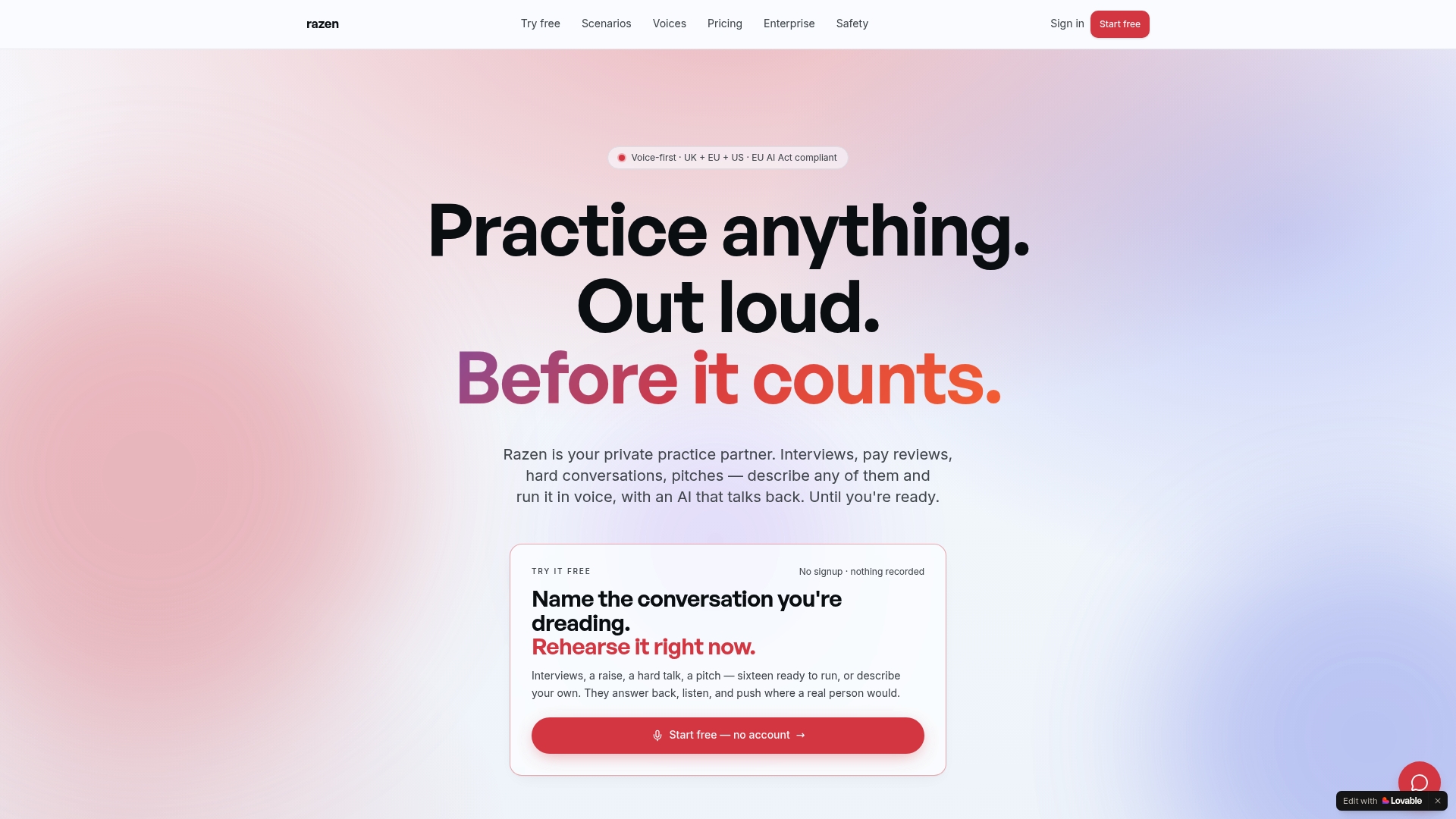
Three short sessions, roughly ten minutes each, cover the ground a real meeting demands: a plain read-through, a pushback round where the partner asks “why me?” or goes silent, and a logistics run where you practise handing over severance and benefits details without losing your composure. This is rehearsal, not a substitute for your HR and legal process. Documentation, consultation and counsel review still have to happen exactly as your organisation requires. The Pro plan runs £29.99 a month for individual managers who want repeatable practice before high-stakes conversations, and organisations training multiple managers can look at Razen for teams for group licensing. Start with one script and one rehearsal session before your next difficult meeting.
Where to read the primary guidance
- ACAS: redundancy consultations, the definitive UK guidance on meaningful consultation.
- CIPD: managing the redundancy process, covering compassionate, compliant redundancy practice.
- CIPD webinar: how to get redundancies right, on alternatives and mitigation.
Sources
- The manager’s guide to having layoff conversations — because HR can’t do it for you
- Manage staff redundancies: redundancy consultations
- Managing the redundancy process
- The impact of layoffs on survivors: an organizational justice perspective
FAQ
What should you say in a layoff conversation?
Open with the decision itself in the first two sentences: name the role and the final date, without euphemism. Follow with a brief, honest reason, then move straight to logistics such as severance, benefits and a named HR contact.
What is a good script for firing an employee?
A good termination conversation script states the decision plainly, gives one or two sentences of factual rationale (referencing a prior PIP or consultation where relevant), and closes with clear next steps rather than open-ended debate. Keep it under a minute of talking before you pause.
What should you say to someone who’s just been laid off?
Acknowledge the news is hard, avoid false reassurance, and let silence happen rather than rushing to fill it. Offer the practical support you can confirm, such as a reference or the HR contact for severance details, rather than promises you can’t keep.
How do you professionally explain being laid off?
The accepted phrasing is that your role was “made redundant” or “eliminated as part of a restructuring”, which frames the decision as business-driven rather than performance-related. This distinction matters to future employers, and it’s the same ownership language managers are advised to use in the meeting itself.
Recommended
Practise it out loud
Rehearse this scenario now.
Razen is a voice-based AI practice partner. Describe any scenario. Run it out loud. Until you're ready.
Keep reading
- How to Handle a Counter Offer Conversation: Exact ScriptsA counter-offer conversation should start with a pause, not a promise: “Thank you for putting this forward. Please send the full terms in writing, and I’ll respond after I’ve reviewed them.” Use a second question to test whether the offer solves the real problem: “What problem do you believe this offer solves?” Ask for salary, effective date, title, scope, reporting line, development plan, flexibility, benefits, equity and bonus terms. Replace vague promises such as “next cycle” with a month, decision-maker and written commitment. Score money, growth, manager, workload and flexibility from…
- How to Handle a Counter Offer Conversation: Exact ScriptsA salary counteroffer conversation needs a calm boundary before you discuss money: “Thank you for putting this forward. I’m willing to consider it, but I won’t decide in this meeting.” Request the complete proposal in writing, including salary, effective date, bonus terms, title, reporting line, workload and working arrangements. Use a 24-hour review period when practical, and keep your original notice position unchanged while you assess the offer. Compare confirmed terms with the role you accepted, marking each item written, approved, dated or verbal. A higher salary does not fix unclear…
- Flexible Working Request Conversation: Rehearse the MeetingA statutory flexible-working request conversation works best when you connect your proposed pattern to coverage, deadlines and measurable service needs. Rehearse a short opening that states the request, the work it protects and the decision you want: approval, a defined alternative or a fair trial. Prepare answers for all eight statutory refusal grounds, with named owners, handover points, escalation routes and evidence such as response times or missed deadlines. Use the script, “Which specific operational risk should we address, and what evidence would show it is resolved?” Propose a trial…