Rehearse Tough Lines Before Your Performance Review Meeting

Run every performance review meeting as a planned, two-way conversation lasting an uninterrupted session typically lasting about an hour to an hour and a half, not a one-sided report card. It should confirm what’s already been said in regular check-ins, never introduce fresh criticism out of nowhere. If you’re a manager, send the agenda and ask for a self-assessment today. If you’re the employee, ask for both if they haven’t arrived.
TL;DR:
- Performance reviews should be scheduled as reflective, two-way discussions lasting 60 to 90 minutes, not monologues or quick check-ins.
- Managers need to prepare specific, observable examples and objective data to avoid recency bias, while employees should bring evidence and questions for a balanced dialogue.
- Focus on concrete, SMART goals with clear success criteria, and schedule regular check-ins to maintain progress throughout the review cycle.
- Keep salary discussions separate from performance feedback, and document all decisions and action plans promptly within two days to ensure follow-through.
Table of Contents
- What is a performance review meeting?
- How long should a performance review meeting last?
- What do you say in a performance review meeting?
- Setting SMART goals for the next review period
- Handling pay, discipline and difficult moments
- After the meeting: documentation and follow-through
- Rehearse before you walk in
- What actually separates a good review from a wasted hour
- Practise the conversation before you’re in it
- Where this guidance comes from
- Sources
- FAQ
What is a performance review meeting?
A performance review meeting is a formal, scheduled conversation between a manager and an employee to assess work over a set period, agree what’s working, and set direction for what comes next. It’s sometimes called an appraisal, an employee evaluation meeting, or an annual performance assessment, but the mechanics are the same: structured feedback, evidence-based discussion, and a documented set of next steps.
The version that works is a dialogue, not a monologue. Acas frames it as a two-way discussion covering strengths, challenges, and support needs, not a manager reading out a verdict while the employee nods. Getting the format right matters more than most managers assume, because a badly run review can undo months of good coaching in ninety minutes.
Preparing before the meeting: what managers and employees need to bring
Send the invitation roughly two weeks ahead. That gives the employee enough runway to build a proper self-assessment rather than a rushed one, and it should spell out the purpose, a rough agenda, and a request for that self-assessment in writing.
Manager preparation is where most reviews are won or lost. Vague feedback (“you’ve been great this year”) is useless and often reflects recency bias, where the last six weeks overshadow the previous eleven months. Pull together three to five concrete examples for each major point, framed as observable behaviour plus impact, not personality judgements. Managers who prepare specific examples this way are consistently rated as fairer by their teams. Cross-check your impressions against objective metrics where they exist, such as sales figures, project delivery dates, or ticket resolution times.
Employees should come with their own evidence too: a short self-evaluation, examples of wins and struggles, and two or three genuine questions about direction or support.
- Send the invitation with purpose, agenda, and self-assessment request roughly two weeks out
- Manager: gather 3 to 5 concrete examples, check objective data, avoid recency bias
- Employee: complete self-evaluation, bring evidence, prepare questions
- Book a private, quiet room or a properly tested video call, with diary buffers either side
Pro Tip: If you’re managing remotely, test your video link ten minutes early and close every other tab. A frozen screen mid feedback point kills momentum you won’t get back.
How long should a performance review meeting last?
Sixty to ninety minutes, run without interruption. That’s the window recommended for comprehensive annual reviews, and it’s long enough to cover reflection, feedback, and goal setting properly without dragging into fatigue. Anything shorter tends to squeeze out the future-focused half of the conversation, the part that actually matters most.
- Minutes 0 to 10: warm-up, restate purpose, set a collaborative tone
- Minutes 10 to 30: employee self-reflection, in their own words
- Minutes 30 to 55: manager feedback, with concrete examples for each point
- Minutes 55 to 75: discuss and agree 2 to 3 goals for the next period
- Minutes 75 to 90: summarise, confirm next steps, close on a clear note
Never back-to-back these. Acas advises managers to bookend reviews with 10 to 15 minutes of buffer before and after, which sounds like a scheduling nicety until you’ve run four reviews in a row without one and heard yourself repeating the same phrase to the fourth person. Running remote or shorter sessions? Keep the same proportions, just compress the warm-up and lean harder on written notes beforehand so verbal time goes further.
What do you say in a performance review meeting?
Open by naming the purpose out loud, then hand the floor over. Something like: “I want this to be a two-way conversation about the last few months and where we go next. Before I share my view, tell me how you think it’s gone.” That single move changes the entire tone of the room, because the employee talks first rather than reacting to a verdict.
When you do share feedback, anchor every point to two or three specific examples rather than general impressions. “You’re strong on client communication” lands as flattery. “In the Halden account renewal, you caught the pricing error before it reached the client and flagged it within the hour, that’s exactly the kind of ownership I want to see more of” lands as evidence.
Use layered questions to keep it a dialogue rather than a lecture:
- “What got in the way of hitting that target?”
- “What would need to change for that to go differently next quarter?”
- “How did that project compare to what you expected going in?”
For missed targets, lead with curiosity rather than accusation: “The Q3 delivery slipped by three weeks, walk me through what happened.” For defensiveness, slow down and reflect back what you’re hearing rather than repeating your point louder: “It sounds like you felt the deadline wasn’t realistic from the start, is that right?” For a promotion conversation, be direct about the gap: “Here’s what I’d need to see consistently before I could put you forward.”
Close every feedback point by converting it into a feed-forward action rather than leaving it as a criticism hanging in the air.
Pro Tip: Write your three toughest phrases down beforehand and say them out loud in an empty room first. The gap between how a sentence reads and how it sounds coming out of your mouth is bigger than most managers expect.

Setting SMART goals for the next review period
Two to three goals, typically no more. A list of eight objectives is a list nobody remembers by February. Order them by impact, agree what success actually looks like for each, and write them down before the meeting ends, not as a follow-up task for next week.
- Specific: “Reduce average ticket resolution time” becomes “Reduce average resolution time from 48 to 36 hours”
- Measurable: attach a number, a percentage, or a clear deliverable, not a feeling
- Achievable: stretch it, but don’t set a target neither of you believes in
- Relevant: tie it to the role’s actual priorities, not a generic company slogan
- Time-bound: name the date or the review cycle it applies to
Roughly half the meeting should be forward-looking. Framing that leans too heavily on relitigating the last twelve months and too lightly on what happens next leaves both people walking out with no shared sense of direction. Agree the date of the first check-in before anyone leaves the room.
Handling pay, discipline and difficult moments
Keep salary conversations out of the performance review entirely, or at least clearly separated in time. Combine pay and development feedback and the employee hears the number, then nothing else you say registers, which is why separating the two conversations tends to produce better outcomes for both sides.
- Raise underperformance with specific evidence, then invite a response: “I’ve noticed three missed deadlines this quarter, help me understand what’s been happening.”
- If the issue is serious or repeated, say plainly that it may move to a formal process, and document exactly what was discussed and agreed.
- Keep your tone level. Naming what you’re seeing without judgement (“I’m noticing this feels tense, let’s slow down”) de-escalates far better than pushing through a script.
- Never let a review substitute for a disciplinary process. If the conversation has crossed into misconduct or capability procedures, say so and follow your organisation’s formal steps separately.
After the meeting: documentation and follow-through
Send a written summary within about two days, while the conversation is still fresh for both of you. That timeframe correlates strongly with reviews actually leading to change, rather than fading into a forgotten PDF.
- Include the goals agreed, who owns each action, and the deadline for each
- Note it as a factual, objective record, useful if a dispute ever arises later
- Store it in your usual HR system with minimal, relevant personal data, mindful of GDPR
- Book the first check-in within 30 days, then repeat on a regular cadence rather than waiting for the next annual cycle
Rehearse before you walk in
Reading a script silently and saying it out loud are two different skills, and the gap shows up exactly when the conversation gets tense. A short three-round rehearsal, run it once, add pushback, then refine the phrasing, tends to reduce defensive reactions when the real conversation happens.
-
Round one: read your key points aloud, exactly as written
-
Round two: have someone push back or object, and respond in real time
-
Round three: adjust your wording until you can state your core message in one clean sentence
-
If you can’t rope in a colleague to role-play the tough moments, a voice-based rehearsal method fills that gap on your own schedule.
Pro Tip: Rehearse the line you’re most nervous about saying, not the whole meeting. That’s usually the one sentence that decides how the next ten minutes go.
What actually separates a good review from a wasted hour
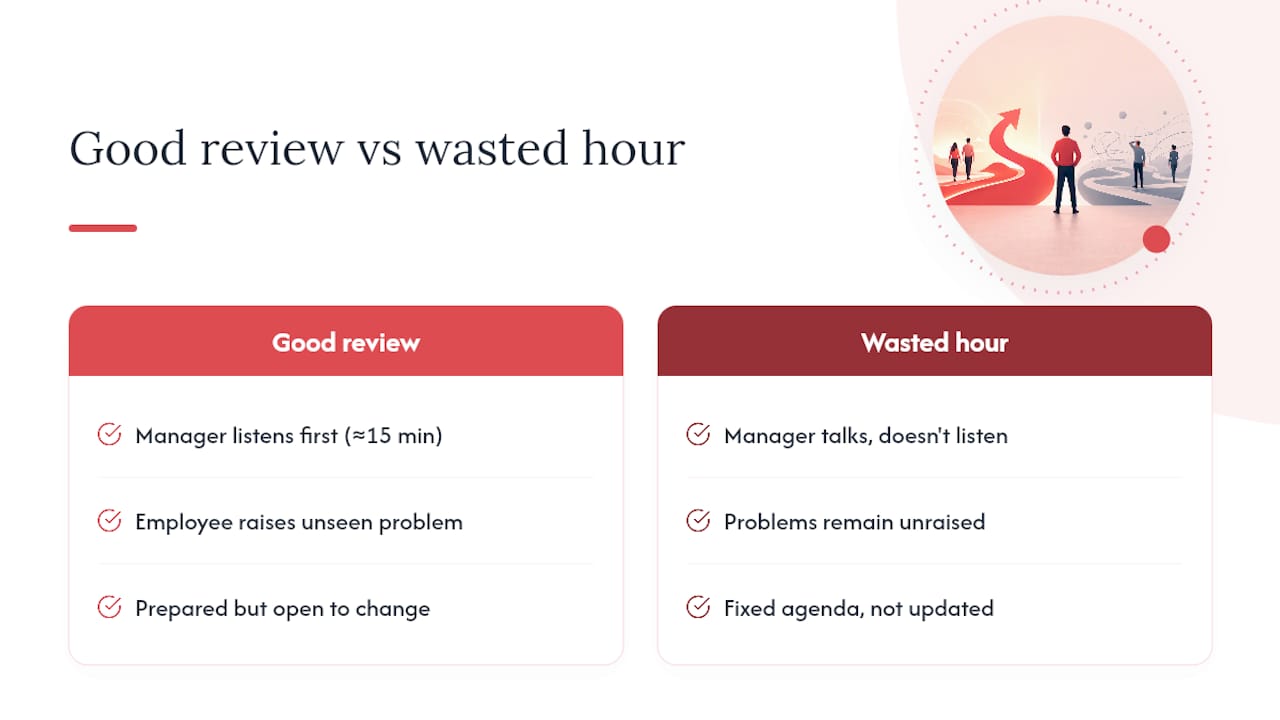
The best review I’ve heard described started with the manager saying almost nothing for the first fifteen minutes, just listening. The employee brought up a problem the manager hadn’t even clocked yet.
The takeaway: prepare your points, then be genuinely willing to let the employee’s version reshape them.
— Nico
Practise the conversation before you’re in it
Razenai is the rehearsal option for managers and employees who’d rather test their phrasing on a realistic conversational partner than wing it in the room. You describe your scenario in a sentence, whether that’s delivering tough feedback, handling a defensive reaction, or opening a promotion discussion, and Razenai’s voice-based AI responds and pushes back the way a real person might, at a difficulty level you choose.
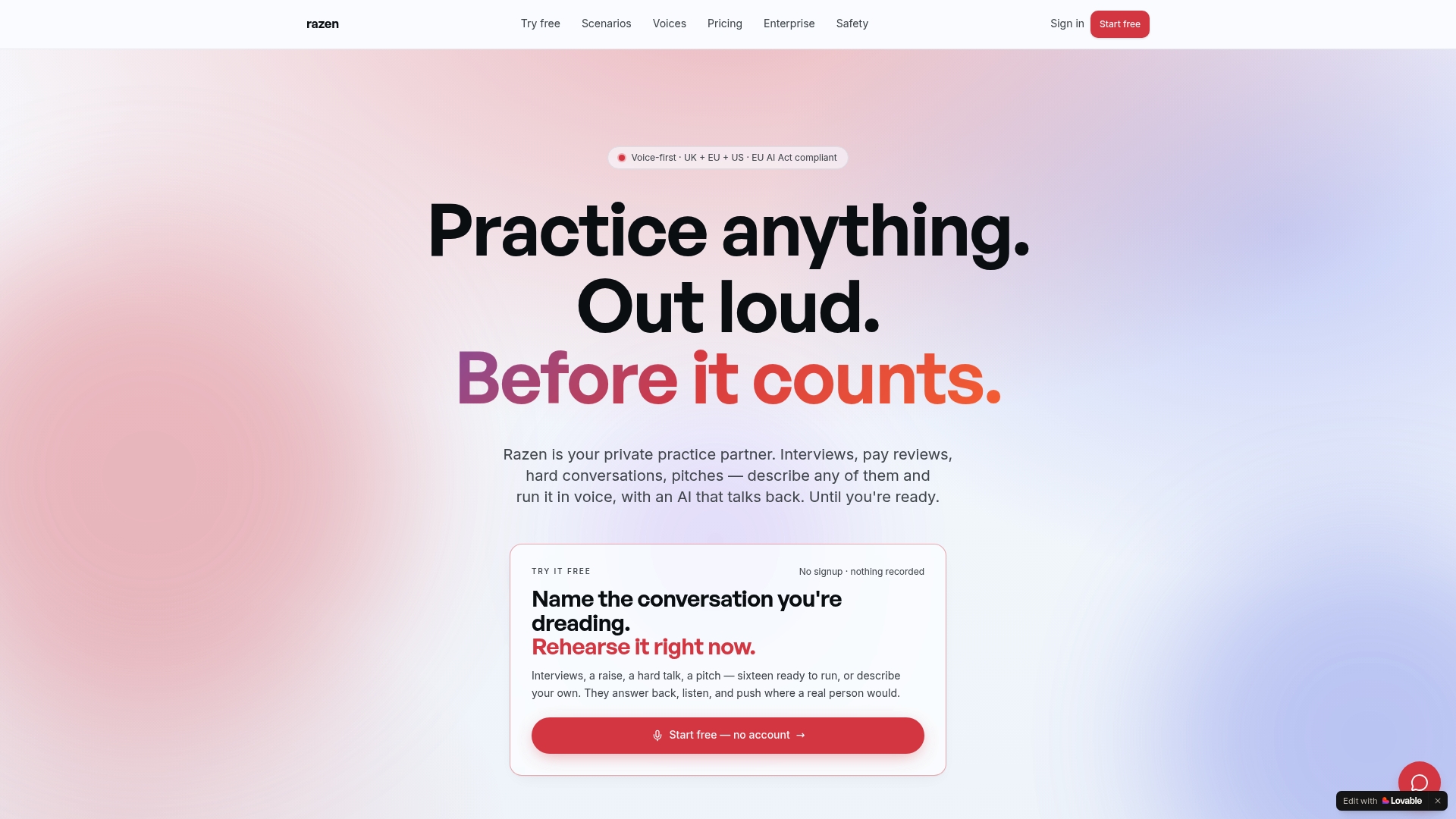
Use it to rehearse the opening line of a difficult review, practise staying level when someone gets defensive, or run through a self-assessment conversation from the employee’s side before you walk in. The scenario library covers workplace conversations specifically, and Razenai’s Coach feature gives feedback on tone as you go. Plans start with a free tier, and paid plans are available for individuals who want unlimited rehearsal ahead of every review cycle. Check the pricing page for the full breakdown, or look at Razenai for Teams if you’re rolling this out across a management group.
Where this guidance comes from
- Acas: Reviews and appraisals, the UK’s core guidance on performance management
- How to run an effective performance review, on timing and structure
- Acas guidance on performance management, summarised for legal defensibility
Sources
- How to run an effective performance review
- Reviews and appraisals - Performance management
- Acas guidance — Performance management (summarised by Menzies Law)
FAQ
What do you say in a performance review meeting?
Open by stating the purpose, invite the employee to reflect first, then share feedback anchored to two or three concrete examples per point rather than general impressions.
What happens in a performance review meeting?
A manager and employee discuss performance over a set period, review strengths and challenges, and agree two to three SMART goals for the next period, typically across 60 to 90 minutes.
Is a performance review a disciplinary?
No. A performance review is a development conversation, not a disciplinary process; if underperformance is serious, that’s raised separately and documented through a formal procedure.
How do I prepare for a performance review meeting?
Managers should gather three to five concrete examples and check objective metrics beforehand; employees should complete a self-assessment and bring their own evidence and questions. Rehearsing tricky phrasing out loud beforehand, including with a tool like Razenai, sharpens delivery before the real conversation.
Recommended
Practise it out loud
Rehearse this scenario now.
Razen is a voice-based AI practice partner. Describe any scenario. Run it out loud. Until you're ready.
Keep reading
- Flexible Working Request Conversation: Rehearse the MeetingA statutory flexible-working request conversation works best when you connect your proposed pattern to coverage, deadlines and measurable service needs. Rehearse a short opening that states the request, the work it protects and the decision you want: approval, a defined alternative or a fair trial. Prepare answers for all eight statutory refusal grounds, with named owners, handover points, escalation routes and evidence such as response times or missed deadlines. Use the script, “Which specific operational risk should we address, and what evidence would show it is resolved?” Propose a trial…
- How to take criticism at work: what to say and rehearseCriticism at work becomes easier to handle when you separate observable behaviour from personal labels and slow your first response. Start with, “I want to understand the specific behaviour you mean before I respond,” then paraphrase the point and ask for one example. Accept valid impact without admitting disputed facts, and convert vague claims such as “not strategic” into a situation, behaviour and expected standard. Use a simple decision rule: ask for evidence, correct the record, or set a boundary when the criticism is unsafe or personal. Rehearse three passes aloud: cooperative…
- First Job Interview Tips: What to Say and RehearseFirst job interviews test how clearly you turn limited experience into evidence of learning, action and improvement. Use a 60–90-second opening that connects one role requirement to a project, course, club, caring responsibility or volunteer example. Prepare in 15 minutes: choose three requirements, build one STAR answer, rehearse four short responses, then reduce your notes to keywords. Keep the Action section focused on what you personally decided and did, and state the result without inventing figures. When you lack paid experience, name a similar responsibility and explain the outcome…