Get the Raise: Salary Negotiation Script with Three AI Rehearsals

Say this once you have an offer in hand: “Thank you, I’m genuinely excited about this role. Based on my research and experience, I was hoping for £X. Is there flexibility on that?” Then stop talking. That single line, backed by one proof point and followed by strategic silence, does more work than any clever tactic. If the recruiter says the base is fixed, pivot immediately to signing bonus, extra leave, or an earlier review.
TL;DR:
- Candidates should research their market rate and walk-away threshold before negotiating, and present one specific, well-supported figure rather than a range.
- Rehearsing the negotiation script aloud and role-playing pushback improves confidence and reduces chances of hesitation or filler words during the real conversation.
- When faced with a fixed base salary, focus on other leverage points like signing bonuses, extra leave, or earlier performance reviews instead of pressing for more cash.
- Using the gratitude sandwich approach—thank you, ask, and collaborative close—outperforms aggressive framing in salary discussions.
- Confirm all verbal agreements with written follow-up before resigning from a current role or accepting an offer.
Table of Contents
- Salary negotiation scripts for the situations you’ll actually face
- How to craft your script: picking your number, proof points and framing
- Exact templates: phone, in-person and email counters you can use verbatim
- Why rehearsal matters more than the words themselves
- Handling pushback and the “this is our best offer” moment
- Accepting or declining: language that closes the deal properly
- Why the script matters less than the rehearsal behind it
- Practise these scripts with Razen before you need them
- Sources
- FAQ
Salary negotiation scripts for the situations you’ll actually face
Most negotiations don’t happen in one tidy conversation. They happen across a prescreen call, a verbal offer, maybe a competing bid from another company, and later a raise request. Each moment needs slightly different wording.
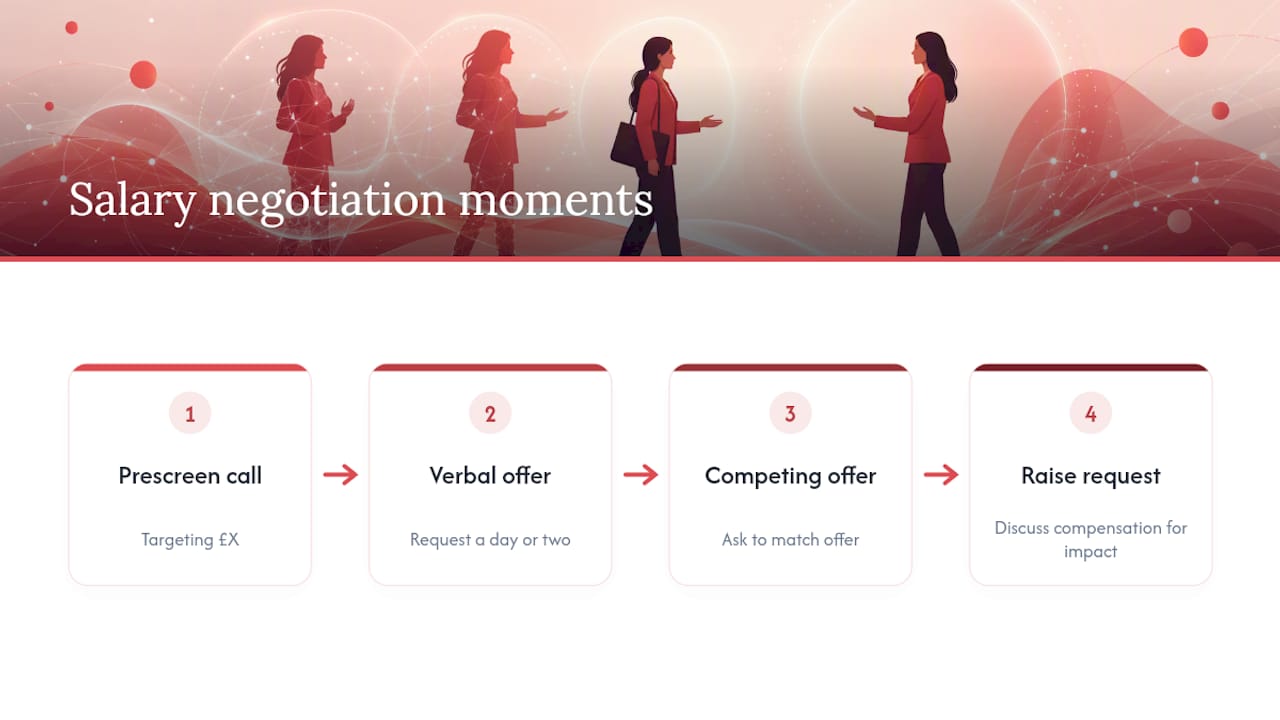
Right after a verbal offer, buy yourself time: “This is great news, thank you. I want to give this the attention it deserves. Could I get back to you after a day or two?” Robert Walters advises against negotiating before an offer exists, so hold this line until you actually have one.
When a recruiter asks your current salary during a prescreen: “I’d rather focus on the value I’d bring to this role. Based on my research, I’m targeting £X for this position.”
Once you’re ready to counter by phone: lead with enthusiasm, name your number, cite one proof point, ask “Is there flexibility?”, then pause.
With a competing offer: “I’ve received another offer with a competitive package. I’d genuinely prefer to join your team. Is there room to match or come close?” State the figure honestly. Bluffing a competing offer is easy to unravel and can cost you the whole deal.
Asking your manager for a raise: “I’d like to discuss my compensation given the impact I’ve delivered this year. Based on specific results and market benchmarks, I think a fair adjustment is warranted. Can we talk through that?”
How to craft your script: picking your number, proof points and framing
Your script is only as strong as the number behind it. Get that wrong and no amount of polished phrasing saves the conversation.
- Research your market rate and your walk-away number before you write a single word of script. Know the floor below which you’d rather decline.
- State one specific figure, not a range. GI Group’s guidance is blunt about why: employers anchor to the bottom of whatever range you give them. If you’re forced into a range, set the bottom at your actual target.
- Back it with exactly one achievement and one market data point. More than that starts to sound like you’re justifying rather than stating.
- Wrap it in the gratitude sandwich. Thanks, then the ask, then a collaborative close: “Is there flexibility?” Scotwork’s research found this exact sequence, enthusiasm, number, proof, question, then silence, consistently outperforms more aggressive framing.
- If the base genuinely can’t move, ask about levers instead: signing bonus, extra PTO, an earlier performance review.
Pro Tip: Write your number and proof point on a sticky note before the call. Nerves make people over-explain, and over-explaining is what turns a clean ask into a rambling one.
Exact templates: phone, in-person and email counters you can use verbatim
Different channels need different structures. A phone call rewards brevity and pauses; an email rewards bullet points and a clear deadline.
Phone or video call: “Thank you so much for the offer, I’m really excited. Based on my research and the value I’d bring, I was hoping for a competitive salary. [Pause.] Is there flexibility there?” Then stop. Let the silence sit until they respond.
In person: “I appreciate this offer and I want to work here. Given [specific skill or achievement] and current market rates for this role, £X feels right. Is there room to discuss that?”
Email counter works well because it creates a written record the hiring team can circulate, according to Glassdoor’s template guidance. A clear subject line and bulleted asks make it easy for a comp committee to act on quickly, a point SalaryScript’s template collection also makes.
| Element | What to write |
|---|---|
| Subject line | “Following up: [Role Title] offer” |
| Opening | “Thank you again for the offer, I’m thrilled about the opportunity.” |
| Ask (bulleted) | Base salary target, signing bonus, or title adjustment |
| Proof point | One line citing achievement or market data |
| Closing | “I’d love to finalise this soon. Could we speak this week?” |
Short add on templates work the same way for signing bonus (“Would a signing bonus help bridge the gap?”), title change (“Could we revisit my title given the scope of this role?”), extra PTO (“Could we add a week of annual leave in place of base?”), and a six month review (“Could we schedule a compensation review at six months tied to specific goals?”).
Why rehearsal matters more than the words themselves
Improvising under pressure is where good scripts fall apart. Nerves push people towards hedging language, over-explaining, or accepting the first number offered, exactly the weak phrasing that well-prepared responses are designed to avoid, according to Randstad UK.
A three-step routine fixes this:
- Read the script aloud two or three times until the phrasing feels natural rather than memorised.
- Role-play the pushback. Have someone (or an AI partner) reply “This is our best offer” or “We don’t have room to move” so you’ve heard the objection before it happens for real.
- Record and review. Listen back for filler words, apologetic tone, or places you rushed past your number.
Practising salary negotiation out loud with escalating difficulty, easy pushback first, tougher objections later, mirrors how Crawljobs’ negotiation research describes effective rehearsal design. The scenario library lets you set difficulty and simulate a recruiter who actually pushes back.
Pro Tip: Rehearse the pause after your number too, not just the words before it. Most people practise the ask and forget to practise the silence, which is often the part that actually gets you the raise.
Handling pushback and the “this is our best offer” moment
When you hear “this is our best offer,” don’t argue the number. Redirect to other levers: “I understand the base is fixed. Would there be flexibility on a signing bonus, additional equity, extra PTO, or an earlier salary review?” Yale’s career development office frames this as negotiating total compensation rather than conceding entirely.
- Stay quiet after each ask, let them respond first.
- Make small, incremental asks rather than one large demand.
- If you need more time to decide: “Could I have until Friday to review this properly?”
- Confirm any verbal promises by email: “Just to recap our call, we agreed on £X plus [benefit]. Could you send an updated offer letter reflecting that?”
Accepting or declining: language that closes the deal properly
Once you’ve reached terms you’re happy with, confirm specifics before celebrating: “This works well for me. Could you send the updated offer letter reflecting £X, [benefit], and start date?” Never resign from your current role until that written confirmation lands in your inbox, a verbal yes from a hiring manager isn’t a contract.
If you’re turning an offer down, keep the door open: “Thank you for the offer and the time you invested in this process. It’s not the right fit for me at this stage, but I’d welcome staying in touch for future opportunities.”
Why the script matters less than the rehearsal behind it
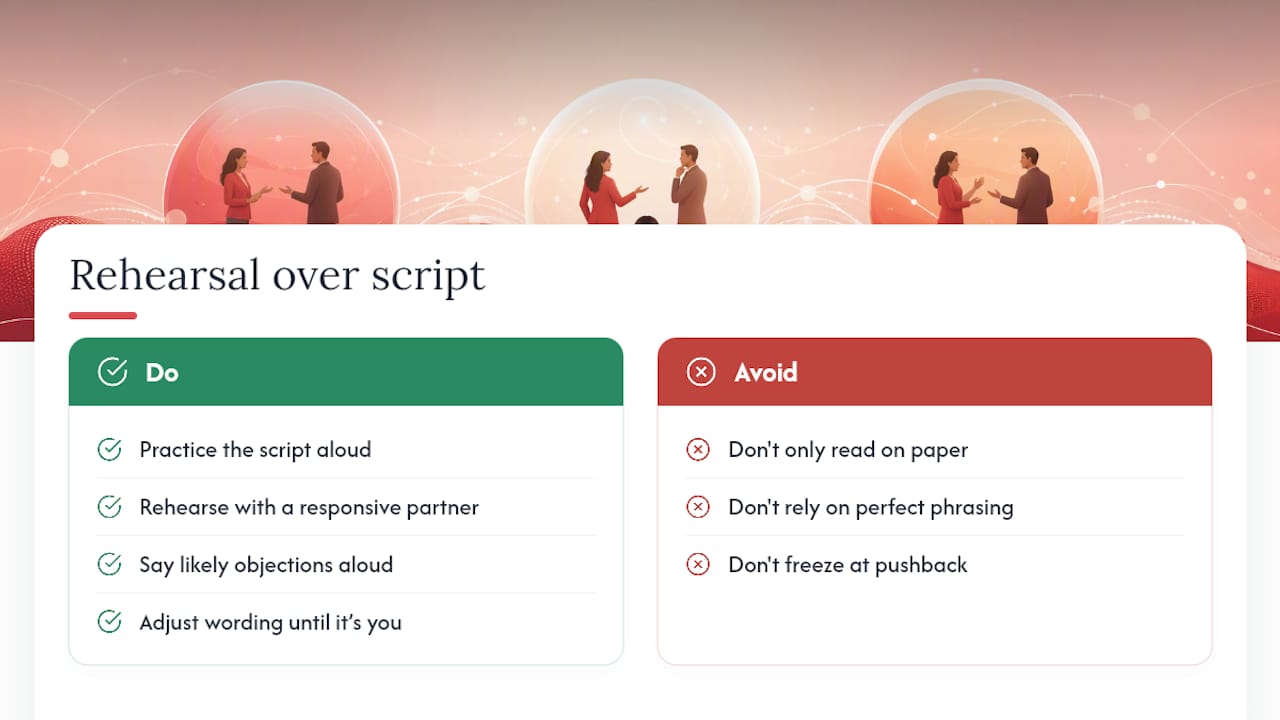
The people who negotiate well aren’t smoother talkers, they’ve just heard the objection before. I’ve watched candidates walk into a counter offer with a perfectly worded script and still fold the moment a recruiter said “that’s a stretch for us,” simply because they’d never heard that specific pushback out loud.
Practising the words on paper isn’t the same as saying them under pressure. Read your script, then say it to another person, or to something that talks back. Adjust the wording until it sounds like you, not like a template.
— Nico
Practise these scripts with Razen before you need them
Reading a script is one thing. Saying it out loud, under mild pressure, with someone pushing back the way a real recruiter might, is what actually makes the words stick. Razen is built for exactly that: describe your scenario in a sentence, and it generates a conversational partner that listens, responds, and pushes back at a difficulty level you choose.
A simple starter routine works well: three sessions of about 10 minutes each. First, read your script aloud solo. Second, role-play it at medium difficulty and let the AI partner object the way a recruiter might (“this is our best offer”). Third, record the session and review it for hesitation, filler words, or places you rushed past your number. The scenario library includes salary negotiation setups ready to adapt to your own numbers and industry. Open a scenario, set your target figure, and run your first rehearsal today.
Sources
- How to negotiate salary | Robert Walters
- How to negotiate salary | Scotwork
- Negotiating non-financial perks | Yale School of Management Career Development Office
- Salary negotiation scripts for any job | Glassdoor
FAQ
What Is a Good Script for Negotiating Salary?
A strong script leads with genuine enthusiasm, states one specific target number backed by a single proof point, asks “Is there flexibility on that?”, then stops talking to let the recruiter respond.
What Is the 70/30 Rule in Negotiation?
There’s no single agreed definition of any numerical split rule in salary negotiation, and it isn’t a standard framework recruiters use. If you’ve seen it referenced, treat it as informal advice rather than an established rule.
How Do You Politely Negotiate a Higher Salary?
Thank the employer for the offer first, then name your researched target figure with one proof point, and frame the ask collaboratively: “Is there flexibility here?” rather than issuing a demand.
What Should You Say While Negotiating Salary?
Say your number once, clearly, then stay quiet. Most people talk past their own ask out of nerves, and that pause is often what prompts the recruiter to move.
When Should You Start Salary Negotiations?
Only after you’ve received a formal written or verbal offer. Negotiating earlier, during screening calls or first interviews, weakens your position because you haven’t yet been chosen for the role.
Recommended
Practise it out loud
Rehearse this scenario now.
Razen is a voice-based AI practice partner. Describe any scenario. Run it out loud. Until you're ready.
Keep reading
- How to Tell Your Boss You Are Resigning: Script and RehearsalResigning from a job starts with a clear decision, not a request for permission. Use the first minute to say, “I’ve decided to resign from my role. My proposed last working day is date, subject to my notice period.” Prepare in 15 minutes by checking your contract, choosing one brief reason, mapping projects and setting boundaries around pay, your next employer and counteroffers. Two weeks is a common benchmark, but your contract and local rules decide the notice period. When your boss pushes back, acknowledge the reaction, repeat that your decision is final and return to the date or…
- How to Give Difficult Feedback to an Employee: ScriptGallup recommends concise, future-focused feedback that gives the employee room to explain, while the manager keeps one observable behaviour and one clear expectation in view. Use this script: “I observed behaviour in specific situation, and the impact was work consequence. How did you experience that?” Listen without arguing, then state the next standard: “In the next task or meeting, please specific action. What support do you need?” Aim for the employee to speak about 70% of the time and the manager 30%. If the issue involves a missed deadline, blocked dependency or serious conduct…
- How to Practise a Panel Interview Alone: Three-Seat RehearsalA three-person panel interview becomes easier to practise alone when you assign each seat a distinct test: HR checks motivation and communication, the hiring manager checks ownership and business impact, and a peer challenges technical choices and trade-offs. Rehearse each seat separately before combining them with interruptions and competing priorities. Keep one evidence card per story, with the situation, responsibility, actions, result, observation and limitation, while changing only the emphasis. Use the STAR structure, record two or three attempts per question, and stop each round only…