12 Copy Ready Sales Roleplay Scenarios and a Manager Scorecard

Sales call role play is the deliberate rehearsal of real selling moments out loud, so reps can practise, get scored, receive feedback and retry. It is not memorising a script or reading lines off a card. This article gives you copy-ready scenarios across four scenario families, a step-by-step runbook for running sessions, a scorecard you can use this week, and a checklist for evaluating AI practice tools.
TL;DR:
- Role play should focus on realistic scenarios with varied resistance levels, especially for new hires, to build trust and readiness for live calls.
- Authentic buyer behavior and clear pass conditions are essential; generic or overly simple scenarios hinder real skill transfer.
- Immediate, specific feedback tied directly to observable actions significantly improves call performance and confidence over time.
- Resistance should increase gradually, only after a rep successfully handles lower-level scenarios twice, to ensure steady skill development.
- AI tools can supplement practice by providing diverse, on-demand scenarios that mirror real objections, but should be paired with human coaching for best results.
Table of Contents
- Why sales call role play actually works
- The four families of scenarios to master
- 12 ready-to-use sales roleplay scenarios
- How to run an effective sales roleplay session
- Calibrating difficulty and matching scenarios to role and tenure
- Scoring, pass conditions and a minimum viable scorecard
- Using AI for on-demand sales call practice
- Common mistakes that make roleplay useless
- Sales roleplay best practices by role
- Building scenarios around your own product and market
- Giving feedback that actually improves the next call
- Getting reluctant reps to actually engage with roleplay
- Try Razen for your next roleplay session
- What actually moves the needle in live calls
- Sources
- FAQ
Why sales call role play actually works
Deliberate, feedback-rich practice is one of the strongest known drivers of skill acquisition, and selling is no exception. Reading a call script or watching a demo video builds recognition, not reflex. Role play builds reflex, because the rep has to produce language under pressure, hear how it lands, and adjust in real time.
The research on sales training specifically backs this up: role play improves live-call performance when sessions use realistic scenarios, include manager feedback, and get repeated often enough to stick. Realism and repetition matter more than polish. A rough scenario run five times with honest feedback beats a slick one run once.
What should you expect if you build this into your training cadence properly? Faster ramp time for new hires, because they hit their first live objection having already handled three fake ones. Better objection handling generally, since reps stop freezing and start recognising patterns. Fewer “I didn’t know what to say” moments on calls that actually matter.
Roleplay earns its place at three points in a rep’s working life: onboarding, where it replaces guesswork with reps; pre-call prep, where it’s used to rehearse a specific upcoming conversation; and quarterly business reviews, where managers use it to diagnose skill gaps before they show up in pipeline numbers.
The four families of scenarios to master
Every sales role play scenario worth running falls into one of four families. Build your library around these, and you cover the moments where deals are actually won or lost.
- Gatekeeper scenarios train reps to get past a screener, receptionist, or assistant without sounding evasive or pushy. The buyer behaviour here is polite deflection: “She’s not available”, “Can I take a message?”, “What’s this regarding?” The skill being trained is framing a reason for the call that earns a transfer rather than a brush-off.
- Cold call and opener scenarios train the first 30 to 60 seconds of an unsolicited call, where most prospects decide whether to keep listening. Buyer behaviour ranges from mild irritation to outright hostility (“Not interested, remove me from your list”). The skill is the pattern interrupt: a hook specific enough that the prospect pauses instead of hanging up.
- Discovery scenarios train reps to uncover business and personal pain that actually drives a purchasing decision, rather than surface-level answers. Buyer behaviour here is guarded or vague (“We’re fine, just exploring options”). The skill is question sequencing: knowing which question unlocks the next layer of truth.
- Close and negotiation scenarios train reps to handle price pushback, competing bids, and stalling tactics without caving or getting defensive. Buyer behaviour includes “Send me a proposal and I’ll think about it” or “Your competitor is 20% cheaper.” The skill is holding value under pressure while still moving toward a decision.
New reps should spend most of their reps on gatekeeper and opener scenarios, since those moments are unforgiving and easy to lose fast. Experienced reps get more value drilling discovery and close, where the skill ceiling is much higher.
12 ready-to-use sales roleplay scenarios
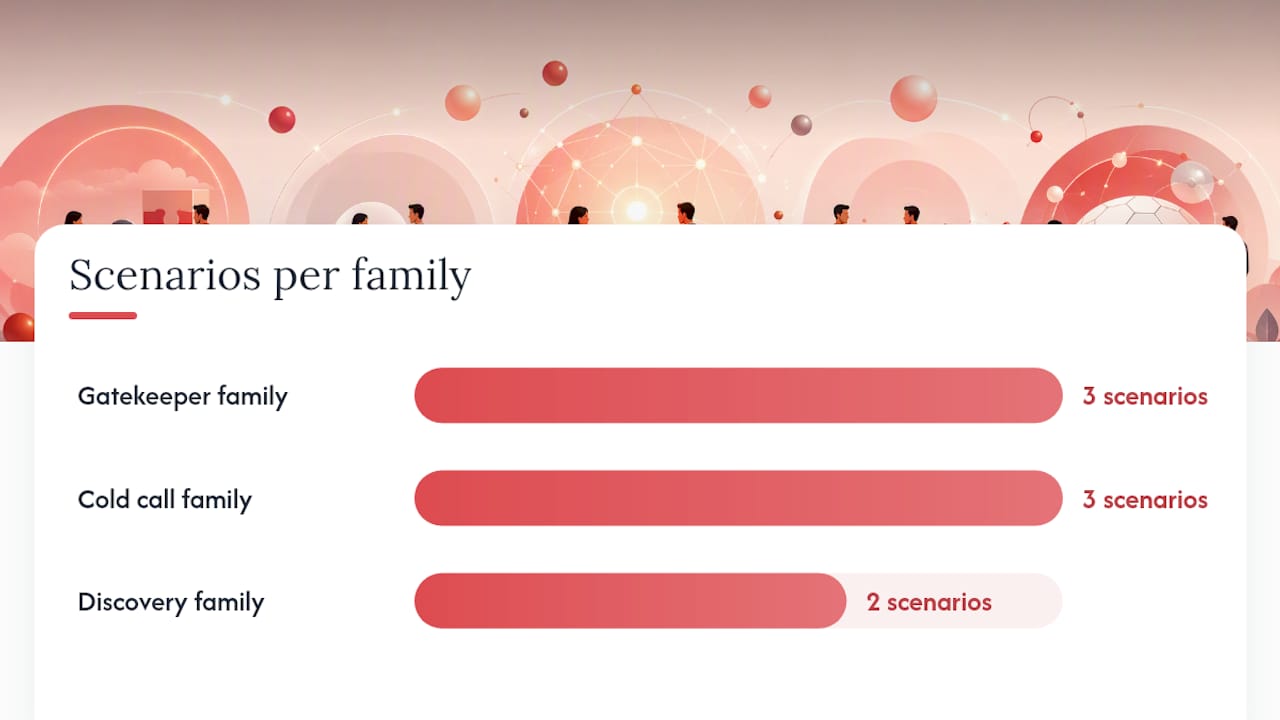
Each scenario below gives you a persona, a starting situation, a pass condition, a resistance level from 1 (soft) to 5 (hard), and starter lines to kick off the conversation. Run each one two or three times with different resistance levels before moving to the next. Repetition with variation, not one perfect run, is what builds the reflex.
Gatekeeper family
-
The busy assistant. Persona: office manager fielding 40 calls a day. Situation: rep calls the main line asking for the VP of Operations. Pass condition: rep secures a name, a callback window, or a direct transfer without misrepresenting the call’s purpose. Resistance: 2. Starter line: “Can I ask what this is regarding before I put you through?”
-
The protective screener. Persona: executive assistant instructed to filter all vendor calls. Situation: rep is told the exec “doesn’t take cold calls, ever.” Pass condition: rep gets the assistant to agree to forward an email or book a 10-minute slot. Resistance: 4. Starter line: “I appreciate the call, but I filter everything for her. She won’t want this.”
-
The suspicious gatekeeper. Persona: assumes every unknown caller is a scam or spam vendor. Situation: rep calls a small business and reaches the owner’s spouse. Pass condition: rep earns 15 seconds of trust and a next step. Resistance: 3. Starter line: “Who gave you this number?”
Cold call and opener family
-
The mildly annoyed prospect. Persona: mid-level manager, three meetings deep already today. Situation: rep opens with a value statement. Pass condition: prospect agrees to a follow-up question or short exploratory call. Resistance: 2. Starter line: “I’ve got two minutes, go.”
-
The outright rejection. Persona: has been burned by vendor calls before. Situation: rep opens; prospect immediately tries to end the call. Pass condition: rep earns 30 more seconds without sounding desperate. Resistance: 5. Starter line: “Take me off your list.”
-
The distracted multitasker. Persona: answers but is clearly doing something else. Situation: half-hearted responses, background noise. Pass condition: rep gets a genuine yes or no on booking time, not a brush-off “maybe”. Resistance: 3. Starter line: “Sorry, go ahead, I’m just finishing something.”
Discovery family
-
The guarded operations lead. Persona: doesn’t want to admit anything is broken. Situation: reveals only surface answers unless asked precisely. Pass condition: rep uncovers one specific, named business pain. Resistance: 3. Starter line: “We’re doing fine, just looking at what’s out there.”
-
The over-sharer with no priority. Persona: talks freely but never lands on what matters most. Situation: rep must narrow a broad conversation. Pass condition: rep identifies the single highest-cost problem and gets it confirmed aloud. Resistance: 2. Starter line: “Honestly, we’ve got about ten things going wrong.”
-
The technical buyer hiding budget reality. Persona: enthusiastic about features, evasive about who signs off financially. Situation: rep must surface the real decision-maker and rough budget range. Pass condition: rep gets a name or a number, even an approximate one. Resistance: 4. Starter line: “I love this, but I don’t handle the budget side.”
Close and negotiation family
-
The price objector. Persona: has a competing quote 20% lower. Situation: rep must defend value without immediately discounting. Pass condition: rep reframes on value or secures a next step without capitulating on price in the first exchange. Resistance: 4. Starter line: “Your competitor quoted us less for basically the same thing.”
-
The classic stall. Persona: agrees the product is right but won’t commit. Situation: rep must convert “let me think about it” into a concrete next step. Pass condition: rep secures a specific date, action, or condition for decision. Resistance: 3. Starter line: “This all looks good, send over a proposal and I’ll get back to you.”
-
The internal-approval blocker. Persona: claims they need sign-off from someone not on the call. Situation: rep must test whether this is a real blocker or a soft no. Pass condition: rep gets agreement to a joint call with the actual decision-maker. Resistance: 5. Starter line: “I’d need to run this by my partner first.”
Each scenario works best when hidden facts, like the real budget or the actual decision-maker, only surface after the rep asks the right question. That reveal-on-request structure forces reps to earn information instead of being handed it, which is closer to how real discovery calls unfold.
How to run an effective sales roleplay session
A good session takes 20 to 30 minutes and has four fixed roles: the rep being trained, a “buyer” playing the persona, an observer taking notes against the scorecard, and, ideally, a manager who runs the debrief. In smaller teams, the observer and manager can be the same person.
- Set the scenario (5 minutes). State the persona, the situation, and the pass condition aloud so everyone starts from the same brief.
- Run the conversation (5 to 12 minutes). No pausing mid-call to correct the rep. Let it play out, mistakes included, because a run that stops and restarts teaches nothing about recovery under pressure.
- Self-review (2 to 3 minutes). The rep speaks first: what worked, what they’d change, one specific line they’d rewrite.
- Observer and manager feedback (5 minutes). One strength, one improvement, one concrete retry instruction, tied to the scorecard rather than a general vibe.
- Retry. The rep runs the same scenario again immediately, applying the one instruction. This single repeat, done right after feedback, is where most of the actual improvement happens.
A few things separate a session that transfers to live calls from one that doesn’t:
- Keep the buyer’s behaviour consistent with the persona brief. A buyer who improvises wildly off-script teaches the rep to handle chaos, not the actual objection.
- Never let the observer interrupt mid-call. Save everything for the debrief.
- Tie at least one scenario per session to a real deal currently in the pipeline. Scenarios built from actual call patterns transfer to live conversations faster than generic ones.
- Rotate who plays the buyer. A rep who has played a hostile gatekeeper understands that persona better when they next face one for real.
Calibrating difficulty and matching scenarios to role and tenure
Resistance level 1 is a warm, agreeable buyer who mostly just needs information. Level 3 is a realistic mixed bag: some genuine interest, some real objections, the kind of call a rep faces most days. Level 5 is closer to a worst case: outright hostility, a hard no repeated twice, or a buyer actively trying to end the call in the first ten seconds.
Matching difficulty to tenure matters more than most training plans admit:
- New hires (0 to 3 months): gatekeeper and opener scenarios, resistance 1 to 3. The goal is building comfort with the mechanics before adding pressure.
- Intermediate reps (3 to 12 months): discovery and early-close scenarios, resistance 2 to 4. This is where question sequencing and objection handling get real reps.
- Senior reps and team leads (12+ months): close and negotiation scenarios, resistance 3 to 5, plus scenarios built from the toughest recent deals lost.
Pro Tip: Increase resistance by one level only after two consecutive passes at the current level. Jumping straight from a level 2 to a level 5 buyer teaches panic, not skill. Progressive overload works the same way in sales training as it does in physical training.
Scoring, pass conditions and a minimum viable scorecard
Vague feedback like “that was pretty good” trains nothing. What works is scoring against observable behaviours, each with real evidence attached.
Score these six criteria on every call:
- Opened with a clear agenda or reason for the call
- Asked questions that uncovered new information, not ones the buyer had already answered
- Listened without interrupting or rushing to pitch
- Named the buyer’s problem back to them in plain language
- Responded to pushback without either caving or getting defensive
- Closed with a specific, named next step
Score each criterion 1 to 4, with no neutral midpoint. Research on skill assessment shows this forces a real judgement call rather than a comfortable “it was fine” default, and produces clearer retraining outcomes than open-ended labels like “good” or “needs work.”
Every score should link to a specific quote or moment, not a general impression. If a rep scores a 2 on listening, the feedback should name the exact line where they cut the buyer off, then give one concrete retry instruction. “Ask one more question before you respond next time” is usable. “Listen more” is not.
Using AI for on-demand sales call practice
AI role-play tools solve a real scheduling problem: you cannot always find a manager and a spare colleague at 8pm before tomorrow’s big call. That is where AI earns its place, giving reps unlimited repetition, a consistent buyer persona that doesn’t get tired or distracted, and an objective baseline score that doesn’t vary by which manager happens to be free that day.
AI is not a full replacement for human-led practice, though. A manager watching a real session catches nuance an algorithm still misses, like tone that reads as confident on a transcript but sounded arrogant out loud. The strongest setups pair AI practice for volume and repetition with human coaching for judgement calls, and tie the scenarios back to real pipeline situations rather than generic buyer archetypes.
If you’re evaluating a sales role play tool, check it against five things:
- Persona realism. Does the AI buyer push back in ways that resemble a real objection, or does it fold after one line?
- Scoring transparency. Can you see exactly why a call scored what it did, tied to specific moments in the transcript?
- Coaching workflow. Does it integrate feedback and retries, or just spit out a number and stop?
- Integration. Does it fit into how your team already runs pre-call prep and onboarding?
- Data privacy. Where are conversations stored, and who can access them?
Pro Tip: Run the same scenario through an AI tool and a live human buyer once, then compare the feedback. If the two agree on the biggest weakness, trust the AI score for future solo sessions.
An AI role-play tool was built around this exact gap: a rep describes a scenario in one sentence, and the AI generates a realistic conversational partner that listens, pushes back, and scores the conversation, with difficulty settings that map directly to the resistance levels above. It’s designed for the moments between formal training sessions, when a rep just needs one more run before a call that matters.
Common mistakes that make roleplay useless
Most failed roleplay sessions trace back to a handful of repeat offenders.
- No clear objective. A session that starts with “let’s just practise a call” instead of a named pass condition produces vague feedback and no measurable progress. Fix: state the scenario’s pass condition out loud before starting.
- Unrealistic buyer behaviour. A buyer who caves too easily, or who improvises wildly off the persona brief, teaches the wrong lessons. Fix: brief the buyer role as carefully as the rep role.
- Stacking too many skills at once. A scenario trying to train discovery, objection handling, and closing simultaneously overloads the rep. Fix: one primary skill per scenario, one supporting skill at most.
- Weak or generic debrief. “Good job, keep going” teaches nothing. Fix: one strength, one improvement, one retry instruction, each tied to a specific moment.
Sales roleplay best practices by role
Different roles need different drills, not the same generic scenario run by everyone on the team.
SDRs get the most value from short, focused drills on the first 60 seconds of a call and the pattern interrupt that keeps a prospect listening. Two to five minute reps, repeated many times in a single session, build this reflex faster than one long call. Practising the opener alone, out loud, before a session with a colleague, works the same way rehearsing an interview opener alone sharpens delivery before the real thing.
AEs benefit from multi-stage drills that run discovery into a tailored demo into negotiation, since that’s the shape of most real deal cycles. Running all three stages back to back, rather than in isolation, trains the transitions, which is often where deals actually stall.
CSMs need scenarios built around renewal conversations, escalation calls from an unhappy customer, and expansion pitches to a happy one. These calls carry different emotional stakes than net-new sales, and the buyer persona should reflect that: someone with history, not a stranger.
Managers running the coaching side should focus on two things: watching for the moment a rep either earns or loses control of the conversation, and phrasing feedback as a specific, evidence-backed observation rather than a general impression.
- Watch for filler and hedging language in the first 20 seconds
- Note the exact question that either opened up or shut down the conversation
- Phrase feedback as “when you said X, the buyer did Y” rather than “you seemed nervous”
Pro Tip: Managers should play the buyer role themselves at least once a quarter. It’s the fastest way to understand what your reps are actually up against.
Building scenarios around your own product and market
Generic scenarios teach generic skills. The fastest way to make role play actually change live-call outcomes is to build scenarios from your own pipeline, not from a template written for a different industry.
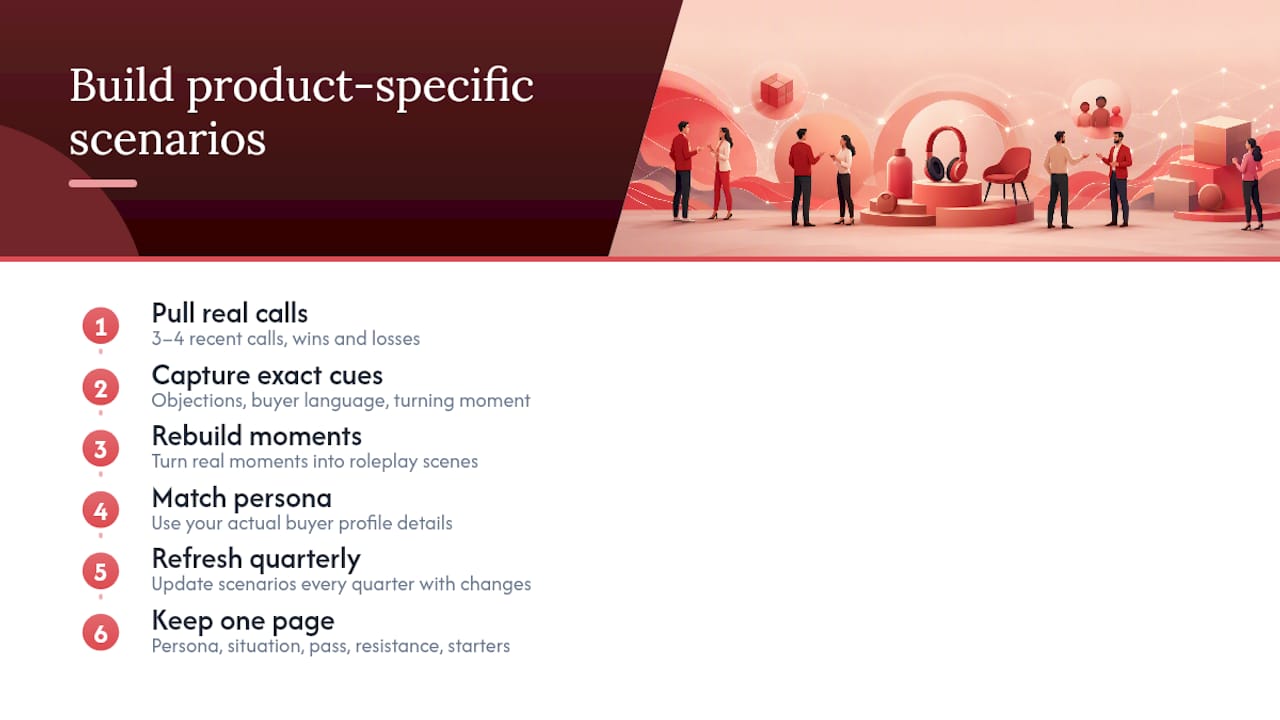
Start by pulling three or four recent calls, ideally a mix of wins and losses, and note the actual objections raised, the actual language the buyer used, and the actual moment the conversation turned. Rebuild those moments as scenarios rather than inventing hypothetical ones. A scenario copied from a real lost deal, where the prospect said “we already have a vendor for this,” trains reps on the exact objection they’ll hear next week, not a sanitised version of it.
Match the persona to your actual buyer profile. If you sell into healthcare, your gatekeeper scenario should reflect how a hospital front desk actually screens calls, not a generic office receptionist. If your average deal size means procurement gets involved at $50,000, build a negotiation scenario around that exact threshold rather than a round number that doesn’t match reality.
Update the library every quarter. Markets shift, competitors change their pitch, and the objections your reps hear this quarter won’t be identical to last quarter’s. A scenario library that never changes trains reps for a market that no longer exists.
Keep each custom scenario to one page: persona, situation, pass condition, resistance level, and two or three starter lines. Anything longer becomes a document nobody reads before a session.
Giving feedback that actually improves the next call
The debrief is where most of the actual learning happens, but it’s also where most sessions go wrong. Vague praise or vague criticism both fail the same way: the rep has nothing specific to change next time.
Anchor every piece of feedback to a specific moment. Instead of “your questions were weak,” say “when the buyer said ‘we’re fine, just exploring,’ you moved straight to pitching instead of asking what prompted the exploration.” That level of specificity is what turns feedback into a rehearsable correction rather than a mood.
Follow the one strength, one improvement, one retry structure every time. Skipping the strength and going straight to criticism makes reps defensive before they’ve even processed the note. Skipping the retry instruction means the feedback has nowhere to land, since the rep never gets to prove they’ve absorbed it.
Let the rep self-assess first. Asking “what would you change about that opener?” before giving your own note does two things: it surfaces whether the rep already knows their weak spot, and it makes the manager’s feedback land as confirmation rather than correction.
Time-box the debrief to five minutes. A ten-minute lecture after a five-minute roleplay teaches the rep that mistakes lead to long lectures, which quietly discourages them from taking risks in the next run.
Getting reluctant reps to actually engage with roleplay
Resistance to roleplay is almost always about discomfort, not disagreement with the method. Reps feel exposed practising in front of colleagues, especially early in tenure, and that discomfort shows up as reluctance, deflection, or going through the motions without real effort.
Normalise the awkwardness directly instead of pretending it isn’t there. Telling a new rep “this feels stiff for everyone the first few times, that’s normal” does more to lower defences than skipping the topic entirely.
Start reluctant reps with solo practice before group sessions. A rep who has rehearsed an opener alone, the way you’d rehearse a difficult conversation before bringing it to a real audience, walks into a group session with far less anxiety about being caught off guard.
Make the observer role, not just the rep role, something everyone rotates through. Reps who have sat on the other side of the scorecard understand why the feedback is structured the way it is, and stop experiencing it as judgement.
Keep the first few sessions low stakes and low resistance, level 1 or 2 scenarios, so early reps build a track record of passing before facing harder buyers. Nothing kills engagement faster than a rep’s first roleplay being a level 5 hostile buyer that ends in visible failure in front of the team.
Try Razen for your next roleplay session
Reading a scorecard is one thing. Running an actual scenario at 9pm before tomorrow’s call, with a buyer who pushes back convincingly, is another. An AI role-play tool lets you describe a scenario in a sentence and generates a realistic conversational partner that listens, responds, and pushes back at whatever difficulty you set, then gives you feedback you can act on immediately.
The scenario library covers a wide range of difficult conversations beyond sales, but the same mechanics apply directly to cold calls, discovery, and negotiation practice. Teams running this at scale, universities, bootcamps, and sales organisations training multiple reps at once, can look at Razen’s enterprise plans for seat-based access and shared reporting. If you’re practising solo before your next call, Razenai and run the scenario that’s actually worrying you tonight, not a generic one from a template.
What actually moves the needle in live calls
Most training programmes treat roleplay as a box to tick before a new hire goes live, one session, one pass, done. That’s backwards. The evidence on skill acquisition is clear that repetition with feedback is what builds reflex, not a single well-rehearsed run. A rep who practises the same tough objection five times, with a sharp retry instruction each time, will outperform one who nails a single polished roleplay and never revisits it.
The other thing most teams get wrong is treating every scenario as equally difficult. Resistance calibration isn’t a nice-to-have, it’s the difference between a session that builds confidence and one that quietly teaches a rep to dread practice. Start too hard, and reps learn to fear roleplay rather than use it.
Here’s a printable checklist worth pinning above your desk: pick one scenario family, set a resistance level matched to tenure, run it, score it against six observable criteria, give one strength and one improvement, then retry immediately. Repeat weekly, not quarterly. That cadence, more than any script or software, is what separates teams whose reps improve from teams that just talk about improvement.
— Nico
Sources
- The making of an expert — Harvard Business Review
- PLOS ONE article on observable skill assessment (DOI)
FAQ
What are some good roleplay scenarios for sales?
Strong scenarios cover the four families that matter most: gatekeeper calls, cold opens, discovery conversations, and close or negotiation moments. The best ones use a realistic persona, a clear pass condition, and hidden facts that only surface when the rep asks the right question.
What is the 30-60-90 rule in sales?
It refers to an onboarding plan broken into three phases: the first for learning the product and process, the second for supervised practice and early calls, and the third for hitting independent targets. Roleplay typically anchors the first two phases, with resistance levels increasing as the rep progresses.
What are the four stages of a sales call?
The four stages are the opening, where the rep sets the agenda and earns attention; discovery, where the rep uncovers the buyer’s real problem; the pitch or demo, where the rep connects the solution to that problem; and the close, where the rep secures a specific next step or commitment.
What is the 2-2-2 rule in sales?
Definitions of this rule vary across sales teams and training programmes, and there’s no single agreed version. Rather than guess at a specific framework, focus on what’s proven to work: repeated practice with feedback, scored against observable behaviours, run often enough to build reflex.
How do I score a sales roleplay session fairly?
Use a scorecard with observable criteria, such as agenda-setting, question quality, listening, and response to pushback, scored 1 to 4 with no neutral midpoint. Tie every score to a specific quote or moment from the call so feedback stays evidence-based rather than a general impression.
Recommended
Practise it out loud
Rehearse this scenario now.
Razen is a voice-based AI practice partner. Describe any scenario. Run it out loud. Until you're ready.
Keep reading
- How to Answer: Tell Me About a Time You Disagreed With Your Manager“Tell Me About a Time You Disagreed With Your Manager” needs a real work example, not a complaint or policy speech. Build a focused 1–2 minute S-T-A-R-B answer: describe the situation and responsibility, state the evidence, quote the key conversation, explain the decision, show how you followed through, and connect the lesson to the role. Choose a meaningful delivery, customer, technical or resource risk rather than a personal preference. The strongest stories show four things: good judgement about when to challenge, respect for context you did not have, a clear recommendation, and…
- DPIA for Voice AI Roleplay: University ChecklistA university careers service should approve voice-AI roleplay only after completing a Data Protection Impact Assessment (DPIA) when processing meets two or more high-risk criteria, such as evaluation, innovative technology, sensitive data, vulnerable students or access to opportunities. The approval record should map recording, transcription, model processing, scoring, feedback, retention, hosting and deletion, then assign each operation a controller or processor role, lawful-basis analysis and accountable owner. Keep the pilot formative: prohibit scores and transcripts from progression…
- How to Answer “Tell Me About a Time You Failed” in an Interview“Tell me about a time you failed” tests whether you own a decision, explain its impact and change the process that caused it. Use a contained example with a clear failure, consequence, lesson and prevention step, such as missing a deadline after starting delivery without confirming the approval path. Keep the failure brief, then focus on what you did after discovering it and how you stopped a repeat. Prepare a 90–120-second core answer, expanding it only for formats that allow more detail. For structured interviews, allocate roughly 30–40% to the failure and 40–50% to the learning. STAR and…